
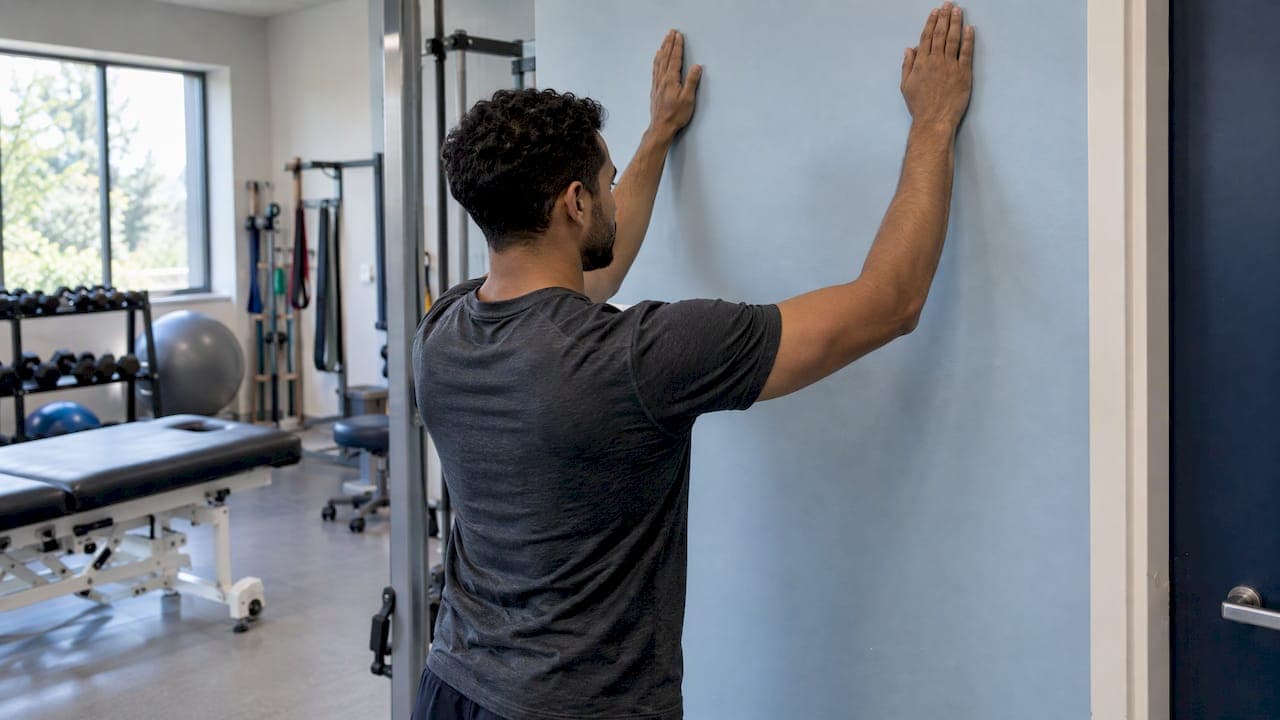
Rehab exercises are prescribed movements that close the gap between what your body can do today and what you need it to do again, whether that is lifting a kettle, reaching overhead or returning to your sport. The right ones depend on the tissue injured, how far healing has come and your goals, so the best programme is individual. This guide explains how exercises are chosen, how to perform them, how to progress them and when to stop, with a focus on the upper body.
TL;DR
- Clinicians choose rehab exercises after assessing your status and goals, then considering the injured tissue, healing stage, irritability and what you need to get back to.
- For shoulder problems, exercise can reduce pain and improve movement and function, whether it is supervised or done at home.
- There is no universal dose. Frequency, sets and repetitions are individualized, and progression comes only after a stable baseline.
- A mild stretch or ache is often normal. Sharp pain, sudden worsening, new numbness or tingling, or new swelling means stop and get advice.
- Exercise videos and guides support a treating clinician's programme. They do not replace an individual assessment.
Table of Contents
- What rehab exercises are and how they are chosen
- Upper body rehab exercises: what they target
- How to perform rehab exercises well
- How often to train and how to progress
- When to stop and get advice
- Rehab exercises for athletes returning to sport
- Fitting exercises into the rest of recovery
- Our perspective
- Explore exercises by region and difficulty
- A simple way to organize your own routine
- FAQ
- Sources
What rehab exercises are and how they are chosen
Think of rehabilitation as a bridge. On one side is your current capacity, which an assessment measures. On the other is a functional goal that matters to you. According to the American Society of Hand Therapists' guide, clinicians select exercises after assessing your status and goals, then considering the tissue involved, the healing stage, how irritable the problem is, impairments, activity limitations, loading principles and the criteria for moving on.
That list explains why two people with the same diagnosis can be given quite different programmes. A person three weeks after a shoulder dislocation and a person with months of stubborn rotator cuff pain are at different points on the bridge.
Timing matters too. The UK's NICE guideline on rehabilitation after traumatic injury says rehabilitation should start as soon as possible, once the person is ready and able to engage, for example to maintain movement, and that plans should be tailored to your agreed goals. Your goals are part of the prescription. "Reach the top shelf" and "return to overhead volleyball" call for very different exercises.
The main types of rehab exercise
Most programmes combine several kinds of work. A recent clinical guideline on a work-related shoulder condition describes active, task-oriented rehabilitation that may combine joint mobility, motor control, strengthening, endurance and education. In plain terms:
- Mobility and range of motion: gentle, controlled movement to keep or regain the joint's available motion.
- Motor control: retraining how muscles coordinate, such as the muscles that steer the shoulder blade during an arm raise.
- Strengthening: progressively loading muscles and tendons so they tolerate more.
- Endurance: building the capacity to repeat tasks without fatigue or pain flaring.
- Task-specific practice: rehearsing the real movements of work, home life or sport.
The same guideline is candid that the best exercise type, dose, pain threshold and choice between supervised and home formats remain uncertain. That is why individualized, shared decision-making is the recommended approach rather than a single fixed routine.
Upper body rehab exercises: what they target
The upper body is a chain: the neck and thoracic spine, the shoulder blade, the shoulder joint, the elbow, the wrist and the hand. A problem in one link often changes how the others work, so good rehab usually looks beyond the sore spot.
Shoulder
The shoulder has the strongest evidence base. A review in the Journal of Orthopaedic & Sports Physical Therapy found that shoulder exercises reduce pain and improve movement and function. Common programmes strengthen the muscles around the shoulder and shoulder blade and improve mobility or movement quality. A systematic review of 76 studies found strong evidence that range-of-motion exercises, strengthening exercises and joint mobilization can improve function and reduce pain in adults with musculoskeletal shoulder conditions.
For rotator cuff tendinopathy, the 2025 JOSPT clinical practice guideline recommends an active, individualized programme that may include motor-control and resistance exercises with varied loads, alongside education about pain, activity modification and self-management.
Different shoulder problems lead to different emphasis:
- Impingement-type pain: rehab typically focuses on shoulder blade control and cuff strength. Our shoulder impingement rehab guide and shoulder impingement syndrome recovery plan lay this out step by step.
- After a dislocation: protecting the joint early and rebuilding stability gradually is the priority. See the post-dislocation shoulder rehab guide and the shoulder dislocation recovery plan.
- Stiffness: when the problem is lost motion, the frozen shoulder recovery plan explains how mobility work is staged.
- Feeling unstable: the chronic shoulder instability recovery plan covers control and strength around a loose joint.
If you want to see how the muscles, tendons and ligaments sit together before you start, the shoulder anatomy encyclopedia shows each structure in plain language.
Neck, upper back, elbow and wrist
Shoulder blade muscles attach to the thoracic spine, so mobility and posture work through the upper back often supports shoulder rehab. Our thoracic spine anatomy page explains T1 to T12 and what they do. For the lower arm, the wrist and hand anatomy guide covers the bones, nerves and tendons you will be loading. Region-specific recovery pages are available for the neck and the arm and elbow.
How to perform rehab exercises well
The University of Queensland's RECOVER team gives simple advice for its upper limb exercises: start slowly and choose movement, stretching or strengthening to match your goal. Their guidance on how it should feel is useful for anyone:
- Pick the type that fits your goal. Movement work if you are stiff, stretching if tight, strengthening if weak or deconditioned.
- Begin gently. Use smaller ranges and lighter loads than you think you need for the first sessions.
- Expect a mild stretch or ache. That is often normal.
- If you are sore afterwards, rest and try a little less next time. Soreness is information about dose, not a verdict on the exercise.
- Ask your health team. A clinician should judge suitability from your presentation, goals, abilities, preferences and clinical needs.
Beliefs and expectations matter
A 2021 review of rotator cuff rehabilitation notes that programmes should address beliefs, preferences and self-efficacy, and discuss pain expectations so that you can tolerate and stay engaged with the work. If you are anxious that any discomfort means damage, say so at your appointment. Understanding which structure is involved and why it hurts often makes exercises easier to approach with confidence.
Technique cues that apply across the upper body
- Move slowly, with a steady count up and a steady count down.
- Keep the neck relaxed and avoid shrugging the shoulders toward the ears unless the exercise calls for it.
- Stop a rep before form breaks down.
- Keep a short log of exercise, load, repetitions and how the area felt that evening and the next morning.
How often to train and how to progress
People want a number, but there is not one. NICE states that exercise dose and frequency should be determined using clinical judgment and expertise because they differ with individual needs and goals. The ASHT guide treats intensity, volume, frequency and progression timing as clinical decisions that follow assessment, stable baselines and healing-stage considerations.
The 2021 rotator cuff review concluded that rehabilitation should be person-centred, progressive and individualized, with controlled unloading followed by reloading. It reports that supervised and home programmes appear similarly effective at about 12 weeks, while the best sets and repetitions remain uncertain. In practice that means a home programme you can actually keep up is a legitimate way to rehabilitate, provided it has been matched to you.
The levers of progression
A Canadian physiotherapy resource explains that progression may alter resistance, repetitions, frequency or movement, guided by symptoms, ability, goals, mobility, strength, coordination, the demands of daily activities and any injury or surgical precautions. Change one lever at a time so you can tell what your body is responding to.
| Lever | Example in the upper body | Typical sign you are ready |
|---|---|---|
| Resistance | Move from no weight to a light band or dumbbell | Current load feels easy and symptoms settle within a day |
| Repetitions | Add a few reps to each set | Last reps are controlled with good form |
| Frequency | Add a session per week | Recovery between sessions is complete |
| Range | Reach a little higher or further | Current range is pain-free or only mildly uncomfortable |
| Body position | Wall support, then incline, then floor | Easier position is smooth and stable |
| Complexity | Single plane, then multi-direction, then with a task | Basic movement pattern is automatic |
These are illustrations of the levers, not a prescription. A stable baseline, meaning the same exercise feeling similar from session to session, comes before any step up. Surgery-specific or injury-specific precautions override the table, so follow the limits your surgeon or therapist gave you.
When to stop and get advice
Discomfort and warning signs are different things. RECOVER advises that you stop and seek advice for sharp pain, suddenly worsening pain, new numbness or tingling, or new swelling. If you feel faint or have chest pain, call 911 or your local emergency number.
The U.S. National Institute of Arthritis and Musculoskeletal and Skin Diseases adds that you should stop immediately when a movement causes injury pain rather than working through it. It recommends consulting a healthcare provider for severe pain, swelling or bruising, persistent symptoms, inability to bear weight, or deformity.
Mass General Brigham lists further reasons to be assessed: sudden sharp lasting pain, pain that prevents movement, swelling, bruising or deformity, spreading numbness, burning or tingling, and pain at a recent surgical site or a previously healed injury. It also advises medical review when pain limits function for more than three days.
In Canada, your family doctor, a physiotherapist or a walk-in clinic can all be a starting point. If you are recovering from surgery, contact your surgical team first, because their precautions come before any general guidance.
Rehab exercises for athletes returning to sport
Athletes often feel ready before their tissues are. A review of upper-extremity athletic rehabilitation describes four broad phases: acute, intermediate, advanced strengthening and return to activity. Moving on requires restored motion, strength, endurance, proprioception (your sense of joint position), dynamic stability and neuromuscular control.

The same review uses minimal pain or tenderness, full motion and strength, and adequate proprioception and dynamic stabilization as criteria for advancing, and the Bern consensus recommends sport-demand-specific exercise at the end stage. Late-stage work therefore moves from basic strengthening to endurance, balance and position sense, dynamic stabilization, plyometrics (fast, springy loading) and multiplane, sport-specific drills.

The textbook Clinical Sports Medicine describes rehabilitation as a gradually progressed, targeted exercise programme meant to restore function and performance, enable safe, timely return to sport and minimise reinjury risk. It also notes that coaches and strength-and-conditioning staff should become more involved as rehab advances, while the clinical team keeps oversight of milestones and safe transfer to sport.
A practical way to apply this: agree on the criteria before you start, such as pain level, motion, strength and a sport-specific task you can complete. Then progress when you meet them, not when the calendar says so.
Fitting exercises into the rest of recovery
Exercise is one part of a plan. NICE says rehabilitation plans should be individualized and goal-focused and include a suggested programme of therapies and treatments and how they will be delivered. Alongside exercise, that usually means education about your condition, adjusting the activities that aggravate it, and scheduled reassessment.
Activity modification does not mean stopping everything. It means changing how, how much or how often you do the things that provoke symptoms, while you build capacity. The University of Queensland clinicians stress that exercise videos are aids to a treating clinician's programme rather than a substitute for individual assessment, because ability, goals and clinical context decide what is suitable. Use guides to understand and rehearse, and use your clinician to decide.
Our perspective
Most people meet rehab exercises as a printed sheet of drawings with no explanation. They are told what to do, but not which structure they are loading or why it matters. We think that is where many programmes lose people.
At InjuryAtlas we start from anatomy. When you can see the rotator cuff tendons, the shoulder blade muscles and the joint capsule in 3D, a prescribed exercise stops being an arbitrary movement and becomes a way of loading a particular structure. That makes it easier to follow the pacing your clinician sets, to notice when something feels different and to ask better questions at your next appointment.
Our guides are written in plain language, and every injury, symptom and exercise is connected to the structure involved. You can begin from a pain location, a diagnosis or a training goal and follow the links onward. We grade the evidence in our guides so you can see how firm the ground is.
Our aim is to support the collaboration between you and your clinician: understand more, ask more, and take part in your recovery with confidence.
Josh
Explore exercises by region and difficulty
If you are ready to put a plan into practice with your clinician's guidance, InjuryAtlas connects 3D anatomy, pain pinpointing and recovery guides to exercise instruction for the upper body and knee. Our exercise library lets you browse by region and difficulty, and our shoulder recovery hub links each common problem to its structure, symptoms and rehab steps.

Lower-body readers can go straight to knee recovery, the ACL rehabilitation guide or the PCL injury recovery plan. You can also start from the InjuryAtlas home page and search by symptom.
A simple way to organize your own routine
Whatever programme you receive, a consistent structure helps you carry it out and report back accurately.
- Warm up: a few minutes of easy movement for the area.
- Main work: the exercises your clinician selected, in the order given, at the dose agreed.
- Cool down: gentle, comfortable movement.
- Log: exercise, load, repetitions and symptoms that evening and next morning.
- Review: bring the log to your appointment so progression decisions rest on your real response.
If a week goes badly, do not panic. Setbacks and plateaus are expected in rehabilitation, and prescription is meant to accommodate them. Scale back, keep moving within comfort and tell your clinician what changed.
FAQ
How long do rehab exercises take to work?
That depends on the injury, its stage and how consistently you train. In one review, supervised and home programmes for rotator cuff problems appeared similarly effective at about 12 weeks, but this is not a promise for every person or injury. Your clinician can give you a realistic timeline for your situation.
Should rehab exercises hurt?
A mild stretch or ache is often normal, but sharp pain is not. Stop and get advice for sharp pain, sudden worsening, new numbness or tingling, or new swelling. If you are sore afterwards, rest and try a little less next time.
Can I do upper body rehab exercises at home?
Yes, for many people. Evidence suggests home and supervised programmes can be similarly effective over about 12 weeks, as long as the programme is matched to you. Ask your physiotherapist or doctor to confirm the exercises suit your diagnosis, and to give any precautions after surgery or a dislocation.
How do I know when to make an exercise harder?
Wait until the current version feels stable from session to session, then change one thing at a time: load, repetitions, frequency, range, position or complexity. Your symptoms, measured function and goals are the guides, along with any precautions from your injury or surgery.
Sources
- Effective Therapeutic Exercise Prescription: The Right Exercise at the Right Dose (ASHT)
- Rehabilitation after traumatic injury (NICE)
- Rotator Cuff Tendinopathy clinical practice guideline (JOSPT, 2025)
- Diagnosing, Managing, and Supporting Return to Work (JOSPT, 2022)
- Painful Shoulder: Exercise Can Reduce Pain and Improve Function (JOSPT)
- Effectiveness of Occupational Therapy Interventions for Adults With Musculoskeletal Shoulder Conditions
- Upper limb exercise video catalogue (RECOVER Injury Research Centre)
- Current concepts in the rehabilitation of rotator cuff related disorders
- Exercise Progression: From Rest to Return to Sport
- Sports Injuries: Diagnosis, Treatment, and Steps to Take (NIAMS)
- When to Seek Treatment for Workout Pain (Mass General Brigham)
- Rehabilitation and Return to Play of the Athlete after an upper extremity injury
- Principles of sports injury rehabilitation (Brukner & Khan's Clinical Sports Medicine)