
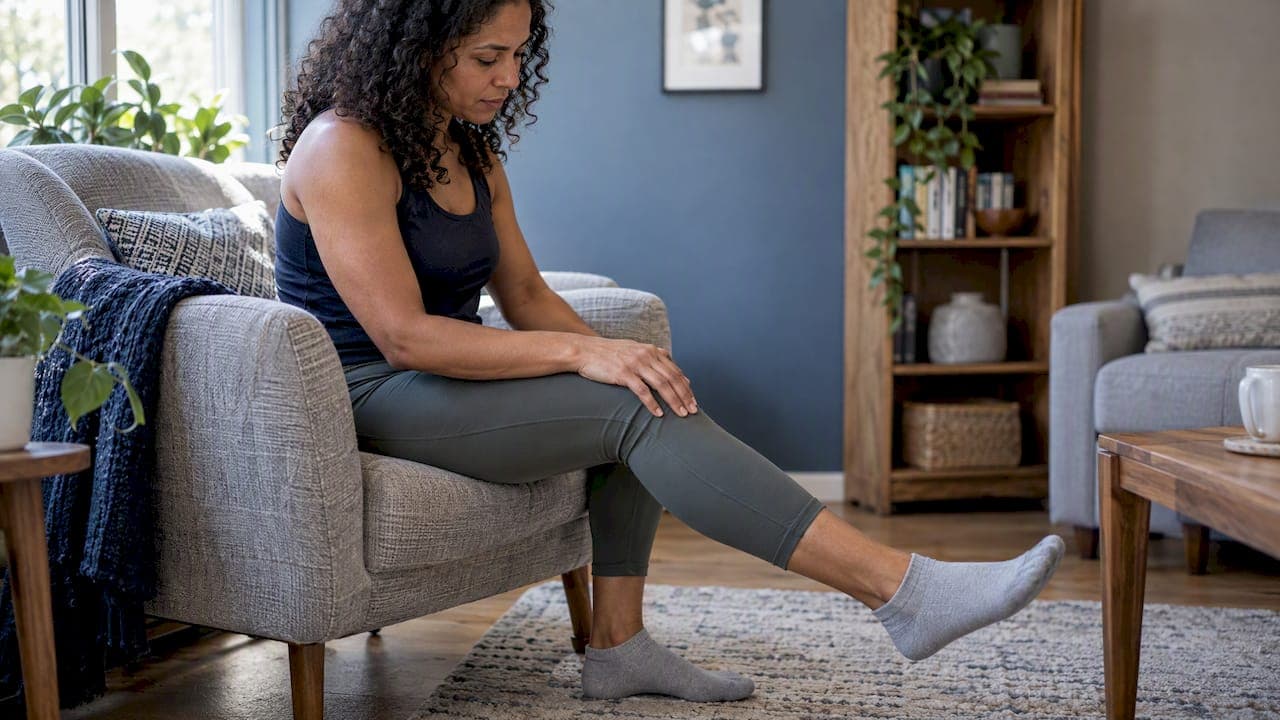
Knee pain when you sit is most often felt at the front of the knee, and a common cause is patellofemoral pain, where the kneecap and the groove it glides in become irritated. Other causes include osteoarthritis, bursitis and tendon problems. The pain tends to build when the knee stays bent for a long time, such as during a film, a flight or a workday. This guide helps you work out where your pain sits, what may be behind it, what you can do today, and when to have it assessed.
TL;DR
- Pain at the front of the knee that builds with prolonged sitting is often patellofemoral pain syndrome (PFPS). Weak quadriceps and overloaded activity are associated with it.
- Pain at night or after rest can come from osteoarthritis, gout or bursitis, because joints lubricate less when still.
- Change position often, use ice for up to 20 minutes, and keep gentle movement going. Stop any exercise that sharply increases pain or swelling.
- See a doctor if there is no improvement after a couple of weeks of self-care, or sooner if the knee is hot, swollen, locked or cannot bear weight.
Table of Contents
- Why a bent knee can hurt when you are not doing anything
- Common causes at a glance
- Front-of-knee pain: patellofemoral pain syndrome
- Night knee pain and pain after rest
- Knee pain while hiking and after hiking
- What to do today when your knee hurts from sitting
- Exercises that may help, and how much pain is acceptable
- Getting back to long sits and long hikes
- When to see a doctor
- Find your pain on the 3D map
- Our perspective
- FAQ
- Sources
Why a bent knee can hurt when you are not doing anything
Sitting looks passive, but it holds the knee in a bent position for a long time. In that position the kneecap presses against the end of the thigh bone, and the tissues around the joint stay in one shape. When you then straighten the leg or stand up, the pain often shows up.
According to a clinical review in American Family Physician, PFPS causes pain in or around the front of the knee that gets worse when the knee is bent under load, and long periods of sitting with the knee bent may also aggravate pain or stiffness. The same review notes that PFPS is usually diagnosed from your history and a physical exam, so imaging is not needed to identify it.
Three patterns are worth noticing, because they point toward different causes:
- Pain while sitting, easing when you straighten or walk. This is typical of kneecap irritation.
- Stiffness and pain when you first stand up after sitting. Often seen with joint wear or a joint that has been still.
- Pain that wakes you at night. This has a wider list of possible causes and deserves closer attention.
Common causes at a glance
| Likely cause | Where it hurts | What it feels like | Typical trigger |
|---|---|---|---|
| Patellofemoral pain | Front of the knee, around or behind the kneecap | Dull ache, sometimes grinding | Long sitting, stairs, squatting |
| Knee osteoarthritis | Often diffuse, sometimes inner side | Stiffness, aching after rest | Rest, then first steps; higher-impact activity |
| Prepatellar bursitis | Directly over the kneecap | Tenderness, swelling | Kneeling, direct pressure |
| Gout | Whole joint | Sudden, hot, very painful | Often flares at night |
| Patellar tendinopathy | Just below the kneecap | Pain with loading | Stairs, hills, jumping |
| Iliotibial band syndrome | Outer knee | Sharp or burning | Running, downhill walking |
This table is a map for conversation with a clinician, not a diagnosis. Many people have more than one contributor.
Front-of-knee pain: patellofemoral pain syndrome
If your pain sits around or behind the kneecap and gets worse on stairs, squats or long sits, PFPS is the first thing a clinician will consider. It is sometimes called runner's knee, though you do not need to run to get it.
One factor linked to it is muscle strength. The AFP review reports that lower quadriceps strength is associated with a higher risk of PFPS, probably because it can lead to the kneecap not tracking steadily. That is why most self-help plans include strengthening the thigh and hip muscles rather than only resting.
If you want to see how the structures fit together, our knee recovery hub connects the anatomy of the kneecap and thigh muscles to the exercises used in rehabilitation. Pain when squatting has its own overlap with this problem, and we cover it in knee pain when squatting.
Night knee pain and pain after rest
Searches for night knee pain are even more common than searches for sitting pain, and the two are related. Cleveland Clinic explains that when you are not moving, your joints lubricate less, which can make knee pain more noticeable. It lists osteoarthritis, gout and prepatellar bursitis among the possible causes, and advises bringing it up with a healthcare provider if it disrupts your sleep.
Some practical points follow from this:
- Aching that eases after a few minutes of walking fits a stiff, irritated joint.
- A hot, red, suddenly painful knee is different. That pattern needs prompt medical assessment, not home treatment.
- Swelling over the kneecap after kneeling suggests bursitis. Our guide to knee swelling and when it is serious helps you sort the patterns.
If the pain is behind the knee, on the inner side or on the outer side, the cause list changes. We have separate pages for pain behind the knee, inner knee pain and outer knee pain.
Knee pain while hiking and after hiking
Hiking asks a lot of the knee: long time on your feet, repeated bending on climbs, and heavy loading on descents. Pain during the hike and pain that appears that evening can have different stories.
Pain at the front or just below the kneecap. This can be PFPS or patellar tendon irritation. For the tendon, a UK musculoskeletal service suggests offloading by leading upstairs with the unaffected leg and avoiding hill walking for a time. Hills are the demanding part, so a flatter route is a reasonable stand-in while it settles.
Pain on the outer side. The iliotibial band can become irritated by repeated friction. The American Academy of Orthopaedic Surgeons lists sudden jumps in training volume or intensity and running on uneven surfaces among the risk factors. Rough trail is uneven by nature, so a big increase in distance matters. Read more in our entry on iliotibial band syndrome.
Sitting afterward. Many hikers feel fine on the trail and then stiffen up in the car on the drive home. A bent knee held still after heavy loading often reveals irritation that movement was hiding. Stopping to walk around every so often helps.
A few ways to lighten the load on a hike:
- Build distance and elevation gain gradually rather than doubling them in one trip.
- Shorten your descents or take them slowly, because going down loads the front of the knee.
- Choose well-kept paths while the knee is sore.
- If you run as well as hike, see our guide on knee pain from running.
What to do today when your knee hurts from sitting
The aim is to calm the irritation without letting the joint go stiff. Start here.
- Change position often. Stand, stretch the leg out or walk for a minute regularly. No single position is perfect, so variety is the point.
- Check your seat. If your feet dangle or your knees are much higher than your hips, adjust the height. Feet flat and knees roughly level with hips is a comfortable starting place for most people.
- Use cold if the knee feels sore or puffy. The NHS advises an ice pack or frozen peas wrapped in a tea towel for up to 20 minutes every 2 to 3 hours.
- Consider over-the-counter pain relief. The same NHS page mentions paracetamol (known in Canada as acetaminophen) and ibuprofen gel or tablets. Ask a pharmacist whether they suit you, especially if you take other medication or have stomach, kidney or heart conditions.
- Keep moving gently. Easy walking and the exercises below generally serve the knee better than days of complete rest.
At night, a pillow between the knees when lying on your side, or a small pillow under the knee when lying on your back, keeps the joint from being held at an extreme angle. These are comfort measures, and we are not aware of strong evidence that one position is best for everyone.
Exercises that may help, and how much pain is acceptable
Strength and control around the knee are the heart of most recovery plans. A UK hospital leaflet on anterior knee pain lists active knee bending and pelvic bridges among helpful exercises, and says to stop if an exercise significantly increases pain or swelling.
How do you know whether you are overdoing it? Dynamic Health, an NHS service, gives a practical rule of thumb:
- Pain up to 4 out of 10 during exercise is acceptable if it settles within 45 minutes and does not disturb sleep or next-day activities.
- A big jump in pain, or pain that stays higher for more than 24 hours, can mean you did too much too soon.
If your knee has osteoarthritis, the AAOS notes that swapping high-impact activities such as jogging or tennis for lower-impact ones such as swimming or cycling puts less stress on the joint.
The hips matter too, since they control how the thigh turns and how the kneecap tracks. The clamshell exercise is a common hip-strengthening choice, and you can browse more by region and difficulty in the exercise library. Start with low reps and build over weeks.

If you feel pain in the front of the thigh instead, see quadriceps strain.
Getting back to long sits and long hikes
A flare is a signal about load, so return gradually.
- Week by week, not day by day. Increase sitting tolerance by a few minutes at a time, with a short movement break each time, rather than pushing through.
- Use the 24-hour test. If pain the next day is higher than your baseline, step back to the previous level.
- Return to hiking in stages. Start with flat, shorter routes, then add distance, and only then hills and descents.
- Keep the strength work going after the pain settles. The goal is a stronger thigh and hip, not just a quiet knee.
There is no fixed timeline that suits everyone. If progress stalls, a physiotherapist can tailor the plan.
When to see a doctor
Self-care is reasonable for mild, mechanical pain. The NHS-based guidance says to see a doctor if there are no signs of improvement within a couple of weeks of self-help. Seek care sooner for:
- A knee that is hot, red and very painful, particularly with fever.
- Marked swelling that appears quickly.
- Locking, giving way, or being unable to put weight on the leg.
- Pain that regularly wakes you from sleep.
- Pain after a fall or twist.
In Canada, a family doctor, nurse practitioner or a walk-in clinic is a normal first step, and they can refer you to a physiotherapist or for imaging if needed. In a teenager, growth-related causes are common, so see knee pain in teenage athletes.
Find your pain on the 3D map
If you are not sure where your pain actually sits, start from the body rather than the diagnosis. InjuryAtlas lets you explore the knee in 3D, pinpoint where it hurts and follow connected guides to the structures, symptoms and exercises involved. Begin at InjuryAtlas or browse the Find an Injury page.

Our perspective
We see the same story repeatedly: someone feels a knee ache in a cinema seat, assumes something is "wearing out" and either stops moving or pushes harder. Both reactions can make things worse. In our experience of how people use anatomy guides, the most helpful step is to name the structure involved. Once you know the pain is around the kneecap, or over a bursa, or along the outer band of tissue, the advice becomes specific.

We also think sitting itself is rarely the villain. It is the combination of a long stay in one position with a knee that is already irritated, weakened or recently overloaded. That is why our guides link each symptom to the structure, and each structure to graded exercises, rather than offering one-size-fits-all stretches.
And we want you to work with a clinician. Self-guided reading is for understanding and preparing questions, not for ignoring warning signs.
— Josh
FAQ
Why does my knee hurt when I sit but not when I walk?
The bent position increases pressure between the kneecap and the thigh bone and keeps tissues still, while walking changes the loading and keeps the joint moving. Patellofemoral pain is a common explanation, and AFP notes that prolonged sitting with a bent knee can aggravate it. A clinician can confirm the cause by history and examination.
Why does my knee hurt after sitting, then ease when I move?
A joint that has been still has less lubrication, so stiffness and ache can be most noticeable at first, as Cleveland Clinic describes. Pain that loosens with a few minutes of movement is common in mechanical problems and osteoarthritis. If it keeps happening, have it assessed.
What is the best position for a sore knee?
There is no single best position, and changing positions is more useful than holding one. Keep the knee from staying fully bent for long stretches, use a pillow for comfort at night, and stand up and move regularly. If a position consistently triggers sharp pain, avoid it for now and mention it to a clinician.
Should I stop exercising if my knee hurts?
Not necessarily. Dynamic Health says pain up to 4 out of 10 can be acceptable if it settles within 45 minutes and does not affect sleep or the next day. Stop and reduce the load if pain or swelling rises significantly.
Can hiking cause knee pain that shows up afterward?
Yes. Long climbs, steep descents and sudden increases in distance load the front and outer knee, and symptoms often appear once you stop. Building up gradually and choosing gentler terrain while sore can help. Persistent pain beyond a couple of weeks is worth getting checked.
Sources
- Patellofemoral Pain Syndrome, American Family Physician
- Why Do I Have Knee Pain at Night?, Cleveland Clinic
- Knee pain, NHS
- Knee self-management, Midlands Partnership University NHS Foundation Trust
- Anterior knee pain, Newcastle Hospitals NHS Foundation Trust
- Patellofemoral knee pain, Dynamic Health
- Arthritis of the Knee, OrthoInfo, AAOS
- Knee pain: Patella tendinopathy, Musculoskeletal Matters
- Iliotibial Band Syndrome, OrthoInfo, AAOS