
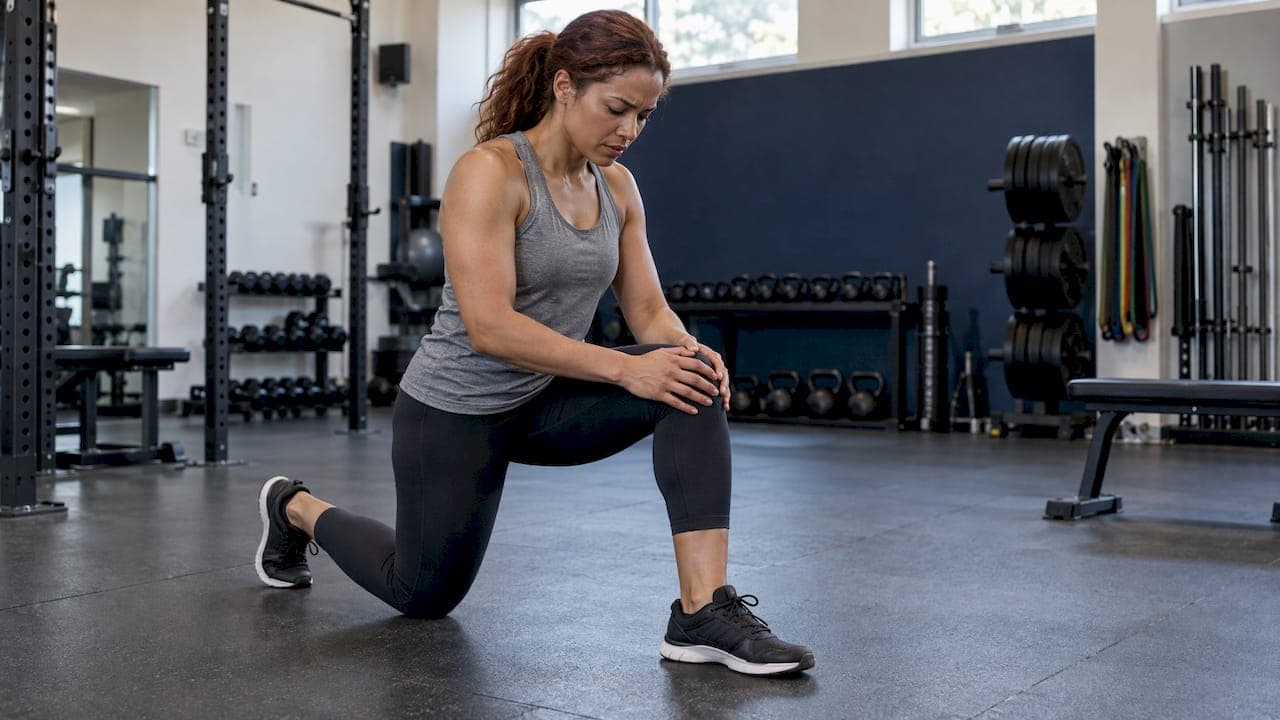
Knee pain during lunges most often comes from the structures at the front of the knee, the kneecap joint and the tendons above and below it, being asked to do more than they are ready for. The cause is usually a mix of lunge technique, depth, load and a muscle or mobility gap, not the lunge itself. Where it hurts tells you a great deal, and a few small changes often let you keep training while the knee settles. A sharp, stabbing pain, swelling or an unstable knee needs assessment first.
TL;DR
- Pain at the front of the knee during lunges is commonly patellofemoral pain or tendon irritation. Pain on the inside or outside points to other structures.
- Stride length, knee position, depth and load all change how much force reaches the kneecap and its tendons.
- Reverse lunges and split squats are common first modifications, and a shorter range can act as a bridge while you rebuild strength.
- Sharp pain, swelling after exercise, locking, giving way or pain after an acute injury means stop and get assessed.
- If pain persists after 10 to 14 days of modifications, see a physiotherapist or doctor.
Table of Contents
- Why lunges can hurt the knee
- Where it hurts: a location guide
- How technique, depth and load change the force on your knee
- What to change so you can keep training
- When to stop lunging and get assessed
- Our perspective
- Find your knee pain on the 3D map
- A simple way to rebuild your lunge
- FAQ
- Sources
Why lunges can hurt the knee
A lunge is a single-leg movement. You balance on a narrow base, bend the front knee deeply and ask the quadriceps to control the descent. That makes it a very good strength exercise, and it also makes it demanding on the knee.
Physical therapist Ginader, speaking to Outside Online, names lunges as the number one exercise that aggravates knee pain. Two reasons are given: many people do forward lunges, which emphasize the quads, and lunges are unsteady, so form errors creep in. He also makes a point worth keeping in mind: the exercise usually exposes an underlying problem, such as muscle weakness or a mobility restriction, rather than causing it. Fixing that problem is what resolves the pain fully.
So the useful question is not "should I stop lunging?" but "which structure is complaining, and what is it reacting to?"
Where it hurts: a location guide
Clinicians narrow down knee pain by asking about its onset, location, duration, severity and quality, plus what makes it better or worse, as described in an American Family Physician review of knee pain evaluation. You can do the same at home. Note the spot, whether it came on suddenly or gradually, and which part of the lunge triggers it.
| Where you feel it | Common causes to consider | What it often feels like |
|---|---|---|
| Front, around or behind the kneecap | Patellofemoral pain, chondromalacia patella, prepatellar bursitis | Dull ache at the bottom of the lunge, worse on stairs and after sitting |
| Just below the kneecap | Patellar tendinopathy | Focal, pointable pain that builds with jumping and deep bending |
| Just above the kneecap | Quadriceps tendinopathy | Pain at the top edge of the kneecap, worse in deep flexion |
| Inside of the knee | MCL injury, medial meniscus irritation, pes anserine bursitis, osteoarthritis | Pain along the inner joint line or just below it |
| Outside of the knee | IT band syndrome, lateral meniscus, LCL | Pain on the outer side, often after running or cycling |
| Back of the knee | Muscle or tendon strain, Baker's cyst, PCL problems | Tightness or pain on straightening or deep bending |
This table follows the location-based approach in the Vim Book residency handbook and the Rules of Four review. It is a map for conversation with a clinician, not a diagnosis. Several of these overlap, and nearby structures can produce similar symptoms.
Pain at the front of the knee
This is the most common lunge complaint. Patellofemoral pain syndrome is pain in the joint between the kneecap and the thigh bone, linked to overuse rather than a single injury. According to Hospital for Special Surgery, people often notice it on stairs (especially going down), after long sitting, rising from a chair, and when squatting, kneeling or lunging. It is usually quieter on level walking.
A classic clue is aching after prolonged sitting, sometimes called the theater sign, as the AAFP differential diagnosis article describes. If that sounds like you, our guide to sitting knee pain explains the link, and the Patellofemoral Pain Recovery Plan lays out a graded way back.
Pain just below or above the kneecap
Tendon pain is easier to pinpoint. A JOSPT paper describes patellar tendinopathy as pain at the lower pole of the kneecap and quadriceps tendinopathy as pain at the upper pole, both most noticeable in deep knee bending. The same authors report that up to 14% of recreational and 45% of elite jumping athletes have patellar tendinopathy symptoms at any given time, so it is common and well understood.
Because these tendons sit right under the skin, the Orthopaedia sports medicine textbook notes that people can often point to the exact spot. If you can say "it hurts right there", look at our patellar tendinopathy guide, the Patellar Tendinopathy Recovery Plan or the Quadriceps Tendinopathy Recovery Plan, depending on which side of the kneecap it is.

Pain on the inside, outside or back
Inner-knee pain can come from the MCL, the medial meniscus or osteoarthritis in the inner compartment, while outer-knee pain is often associated with IT band syndrome, frequently triggered by overuse such as running or cycling, according to HSS's knee pain overview. Pain just below the inner knee, where the hamstring tendons attach, may be pes anserine bursitis, covered in our Pes Anserine Pain Recovery Plan. Pain behind the knee has its own list, including a Baker's cyst and, less often, a PCL problem (see the PCL Injury Recovery Plan).
Muscle pain or joint pain?
Muscle pain tends to cover a broader patch of soft tissue and increases when the muscle contracts or stretches. Joint pain is more centred on the joint and shows up with joint movement or weight-bearing, especially with swelling or reduced movement, as IPS Pain explains. A tight, sore thigh the day after lunges is typically muscular. A localized ache in the knee itself during the movement deserves more attention. A strained quad has its own pathway in the Quadriceps Strain Recovery Plan.
How technique, depth and load change the force on your knee
Small changes in how you lunge shift the load between the hip and the knee. The research gives some specific, practical levers.
Stride length
The National Strength and Conditioning Association notes that a stride that is too short increases stress on the knee, specifically on the patellar tendon. It recommends a distance between the feet greater than a normal walking stride, with both knees bent to about 90 degrees at the bottom if possible.
Knee alignment
The same NSCA article says even a slight inward turn of the lead foot or knee can add torque stress at the front knee. A 2022 study by Gao and colleagues found that knee joint stress, quadriceps strength demand and knee flexion were all greater when the knee travelled in front of the toes, and that keeping the knee behind the toes lowers stress on the patellar tendon. A practical cue: track the knee over the middle of the foot and keep your weight through the whole foot rather than the toes.
Forward, reverse and side lunges
Direction matters. A 2021 study by Goulette and colleagues found the forward lunge produced greater patellofemoral loading than the backward lunge, including higher quadriceps force, joint reaction force and loading rate. Another 2022 study found patellofemoral compressive force and stress were greater in a side lunge than in a forward lunge between 40 and 100 degrees of knee bend. A 2016 conference comparison of lunge techniques reported that the reverse lunge had higher muscle activity with relatively low peak knee shearing force.
Depth and surface
In that same 2022 patellofemoral study, compressive force was greater lunging at ground level than lunging up to a 10 cm platform between 40 and 60 degrees of knee bend. Put simply, the depth and the way you reach it change the load on the kneecap joint. That is why shortening the range is a sensible short-term adjustment.
Added load
Gao and colleagues also found that knee range of motion changed more with barbell loading than with dumbbell loading. If your knee complains once you add weight, going back to bodyweight or lighter dumbbells for a few sessions lets you check technique first.
What to change so you can keep training
Modifications are a bridge, not a verdict. Ginader describes them as a way to keep moving while you address the underlying weakness or restriction. Here is a sensible order to work through.
- Switch to a reverse lunge or split squat. Ginader recommends both for people with knee pain. The shin stays more upright and the load shifts toward the hip.
- Lengthen your stride. Aim for a stance longer than a walking step so the front shin stays closer to vertical.
- Shorten the depth. Go only as low as stays comfortable. Use a pain level you would describe as mild and settling, not sharp or building.
- Hold on for balance. Light fingertip support on a rack or wall reduces wobble, one of the form-error sources Ginader mentions.
- Drop the load. Return to bodyweight until the lunge feels smooth and symmetrical.
- Track the knee. Keep it pointing in line with the middle toes, with no collapse inward.
- Build the supporting muscles. Strengthening the quads and hips with pain-free variations addresses the cause, which is the point of the whole exercise.
When you are choosing alternatives, our Exercise Library lets you browse by body region and difficulty, so you can pick a step-up, bridge or split squat that suits your current level. Our guide to knee pain when squatting covers a closely related set of adjustments.
A realistic timeline
Ginader advises that if pain is still there after 10 to 14 days of modifications, you should see someone rather than keep pushing. That is a useful rule of thumb: you give the changes a fair trial, then bring in a professional.
When to stop lunging and get assessed
Training discomfort that eases within a day is one thing. These signs are different, and a physiotherapist, sports medicine physician or family doctor should look at the knee.
Physical therapist Sommer, quoted by Outside Online, says to get medical help promptly rather than exercising through it if:
- the pain is sharp and stabbing
- the knee swells after exercise
- the pain began with an acute injury, such as missing a step, and the joint is throbbing, feels unstable or keeps clicking
Swelling in particular deserves attention. Our page on knee swelling and when it is serious explains the difference between mild irritation and swelling that needs a check. If a twisting injury has left the knee giving way, an ACL or other ligament injury is possible, and our ACL rehab guide shows what a structured recovery looks like.
If the knee is hot, red and swollen, you cannot put weight on it, or it looks deformed, seek urgent medical care the same day, through an emergency department or urgent care clinic.
Our perspective
Most people who write to us about lunge pain have the same instinct: they assume the knee is "bad" and lunges are off the table. In our experience of building guides around anatomy, that is rarely the most useful way to look at it.
Every knee symptom belongs to a specific structure. Pain below the kneecap involves the patellar tendon. Pain behind the kneecap involves the patellofemoral joint. Pain on the inner side may involve the MCL, meniscus or the pes anserine tendons. Once you know which structure is involved, the right changes become clear: which lunge variation to use, how deep to go, and which muscles to strengthen.
That is why we built InjuryAtlas around anatomy first. You can start from a symptom, a structure or a training goal and follow connected guides from the pain to the recovery plan to the exercises. Our aim is plain, honest language that helps you talk to your physiotherapist or doctor with confidence, not to replace them.
Our advice is to be curious and patient. Find the spot, adjust the movement, strengthen what is weak, and get assessed when the warning signs appear.
Josh
Find your knee pain on the 3D map
If you are not sure which structure is behind your pain, InjuryAtlas lets you explore the knee in interactive 3D, pinpoint where it hurts and follow connected guides covering symptoms, recovery and exercises. With over 79 anatomy guides and a growing encyclopedia, you can go from "it hurts when I lunge" to a plain-language explanation of the structure involved.

Start on the InjuryAtlas home page, or use Find an Injury to search by symptom.
A simple way to rebuild your lunge
Once the pain is settling, bring the lunge back in stages rather than jumping straight to your old routine.
- Stage 1: Pain-free basics. Use controlled bridges, partial-range step-ups and supported split squats with a comfortable stance.
- Stage 2: Reverse lunge to a comfortable depth. Bodyweight only, slow lowering, long stride, steady knee tracking.
- Stage 3: Add load gradually. Try light dumbbells before a barbell, in line with the Gao study's finding that barbell loading changed knee movement more.
- Stage 4: Reintroduce forward and side variations. These put more load through the kneecap joint, so return to them last and only if the knee stays quiet the next day.
A reasonable guide is that mild discomfort which settles within a day is acceptable, but pain that builds during a session or lingers into the next day means you moved up too quickly. Step back one stage. If you have a diagnosed condition, follow your clinician's plan over any general progression.
FAQ
Why does my knee hurt only at the bottom of a lunge?
The deeper you bend, the more load goes through the kneecap joint and the quadriceps and patellar tendons. Pain at the bottom is typical of patellofemoral irritation or tendinopathy. Try a longer stride, a shallower depth and a reverse lunge, and see someone if it lasts beyond 10 to 14 days of changes.
Are reverse lunges better than forward lunges for sore knees?
Often, yes. Research found the forward lunge produced higher patellofemoral loading than the backward lunge, and a physical therapist quoted by Outside Online recommends reverse lunges or split squats. Individual response varies, so choose the version that stays comfortable.
Is it normal for the knee to click during lunges?
Painless clicking is common and not usually a concern. Clicking together with pain, swelling, locking or a feeling that the knee gives way should be assessed, especially after an acute injury.
Can I keep exercising with knee pain?
If the pain is mild and settles quickly, modified training can be a bridge while you strengthen the area. Sharp, stabbing pain, swelling after exercise or an unstable knee means stopping and getting medical advice first.
Does knee pain during lunges mean I have damaged my cartilage?
Not necessarily. Front-of-knee pain is frequently overuse related and tied to load, technique or muscle weakness. Only a clinician can tell you whether cartilage or meniscus is involved, which is why persistent pain deserves an assessment.
Sources
- Outside Online: How to Modify 6 Common Exercises If You Have Knee Pain
- American Family Physician: Evaluation of Patients Presenting with Knee Pain, Part I
- American Family Physician: Evaluation of Patients Presenting with Knee Pain, Part II
- Vim Book: Knee Pain
- The Rules of Four: A Systematic Approach to Diagnosing Knee Pain
- HSS: Knee Pain due to Patellofemoral Disorders
- HSS: Knee Pain Conditions, Causes, Symptoms, Treatments
- JOSPT: Distinguishing Quadriceps Tendinopathy and Patellar Tendinopathy
- Orthopaedia: Disorders of the Extensor Mechanism of the Knee
- IPS Pain: Joint Pain vs Muscle Pain
- NSCA Personal Trainer Quarterly: The Undervalued Lunge
- Goulette et al.: Patellofemoral joint loading during the forward and backward lunge
- Gao et al.: Influence of Different Load Conditions on Lower Extremity Biomechanics During Lunge
- Patellofemoral Joint Loading During the Performance of the Lunge (2022)
- Comparative Analysis of Lunge Techniques: Forward, Reverse, and Side