
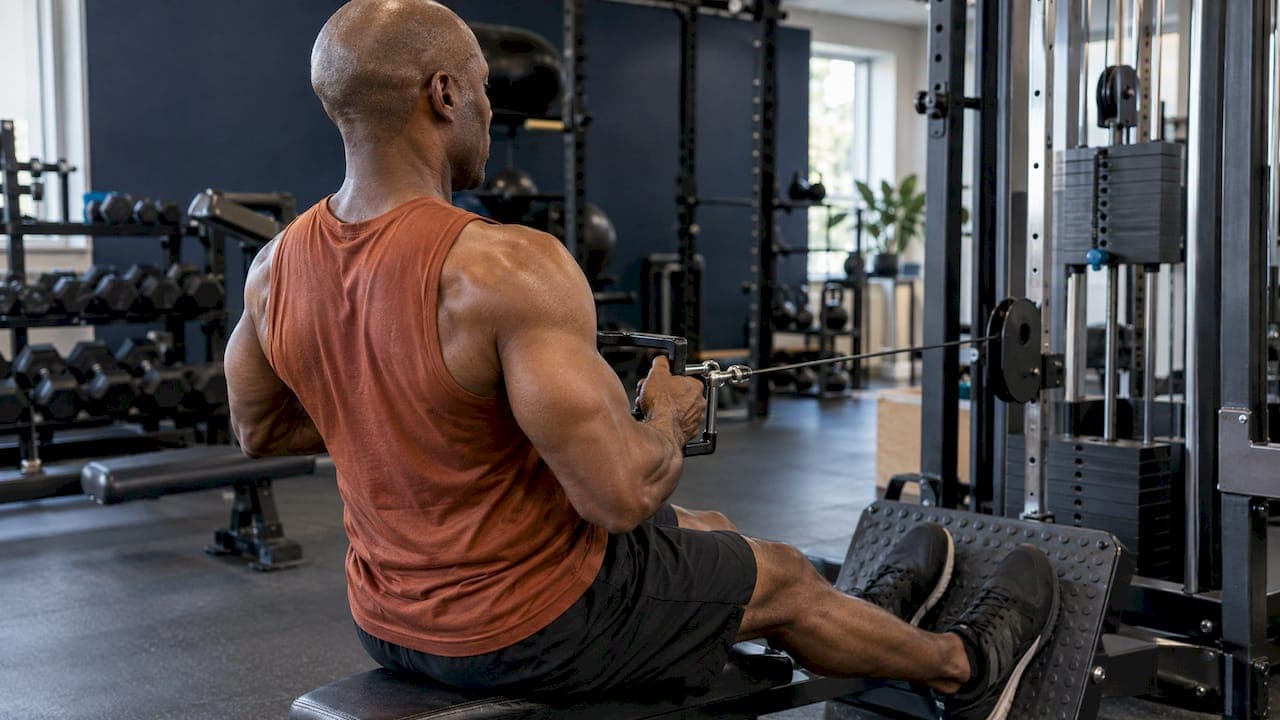
The upper back is built from three layers of muscle that sit between your neck and the bottom of your rib cage. The main ones you can name are the trapezius, the rhomboids, the latissimus dorsi, the levator scapulae and the erector spinae. Together they move your shoulder blades, help your arms reach and pull, and keep the thoracic spine upright. This guide shows where each muscle sits, what it does, how the layers are grouped and how to train them well.
TL;DR
- The back muscles fall into superficial, intermediate and deep layers. The superficial layer (trapezius, latissimus dorsi, rhomboids, levator scapulae) mostly moves the shoulder girdle and arm.
- The trapezius runs from the base of the skull down to the lower thoracic spine and out to the shoulder blade. The rhomboids sit beneath it and pull the shoulder blades together.
- The erector spinae run along the spine and extend and straighten it, so they are the posture muscles of the upper back.
- Rows and Y-T-type raises recruit the upper back well, according to research summarized by the American Council on Exercise.
- Pain between the shoulder blades that lingers, wakes you at night or comes with chest pain deserves a professional assessment.
Table of Contents
- Where the upper back sits
- How the back muscles are grouped
- The superficial muscles you can feel and see
- The deeper muscles that hold you upright
- How the upper back connects to the neck, shoulders and arms
- Where the upper back fits among the upper body muscle groups
- What the upper back muscles do in everyday life and training
- Why the upper back gets sore
- Our perspective
- Explore your upper back in 3D
- FAQ
- Sources
Where the upper back sits
The upper back is the region of the thoracic spine, the twelve vertebrae (T1 to T12) that connect to your ribs. Muscles here do two jobs at once. Some hold the spine and rib cage upright. Others connect the trunk to the shoulder blade (scapula) and arm, so every reach, pull and overhead lift loads them. For a closer look at the bones these muscles attach to, see our thoracic spine anatomy guide.
How the back muscles are grouped
Anatomy texts divide the back muscles into three layers: deep, intermediate and superficial. The grouping is useful because it tells you what a muscle is mainly for.
| Layer | Main muscles | Main job |
|---|---|---|
| Superficial | Trapezius, latissimus dorsi, levator scapulae, rhomboids | Move the shoulder blade and arm |
| Intermediate | Erector spinae (iliocostalis, longissimus, spinalis) and the serratus posterior muscles | Extend the spine and assist breathing |
| Deep | Small muscles along the vertebrae | Fine control and stability of the spine |
The superficial and intermediate layers are called extrinsic muscles, and the deep layer intrinsic, because of their embryological origin, as StatPearls explains. Textbooks do not all place the erector spinae in exactly the same layer, so you may see slightly different tables in different sources. The muscles themselves and their actions are the same.
The superficial muscles you can feel and see
Trapezius
The trapezius is the broad, kite-shaped muscle across the upper back and neck. According to Penn Spine & Orthopedic, it extends from the occipital bone at the base of the skull down to the lower thoracic vertebrae, and sideways to the spine of the scapula. It is usually described in three parts:
- Upper fibres lift (elevate) the shoulder blade. This is the part that tightens when you shrug or hold tension at a desk.
- Middle fibres pull the shoulder blade toward the spine and help it rotate upward. ACE lists scapular upward rotation and adduction for the middle trapezius.
- Lower fibres pull the shoulder blade down (depression), according to the same ACE resource.
If the top of this muscle feels tight, our ear-to-shoulder upper trapezius stretch and the upper trapezius stretch for neck mobility walk you through the positions.
Rhomboids (major and minor)
The rhomboids lie beneath the trapezius, between the spine and the inner edge of the shoulder blade. Their key action is retracting the scapula, which means squeezing the shoulder blades together. This is the movement you feel when you stand tall and "open" the chest, and it is the one rows train directly.
Levator scapulae
This narrow muscle runs from the upper cervical vertebrae down to the top corner of the shoulder blade. It elevates the scapula and helps tilt the neck to the side. Because it links neck and shoulder, it is a common site of that familiar ache at the side of the neck after long hours at a screen.
Latissimus dorsi
The latissimus dorsi, or lats, is the largest muscle in the upper body, spanning from the lower back to the humerus (upper arm bone). Per ACE, its actions are shoulder extension, adduction, horizontal abduction and internal rotation. In plain terms, it pulls your arm down and back, as in a pull-up, a lat pulldown or a swimming stroke. Its lower portion reaches into the lower back, which is why lat work and low back health overlap. If your symptoms sit lower, read our guide to low back strain causes and recovery.
The deeper muscles that hold you upright
Erector spinae
The erector spinae are three columns of muscle running alongside the spine: iliocostalis, longissimus and spinalis. StatPearls describes them as the intermediate group, with a role in moving the thoracic cage and the upper vertebral column. ACE lists spinal extension and lateral flexion as their actions. They work almost constantly in standing and sitting, which is why they respond well to gentle strengthening such as the 45-degree back extension.
Serratus posterior and the small deep muscles
The serratus posterior superior and inferior are thin sheets attached to the ribs that assist breathing. Beneath everything lie the short deep muscles that span one or a few vertebrae. You cannot feel them individually, but they fine-tune each segment of the spine as you twist and bend.
How the upper back connects to the neck, shoulders and arms
The upper back is a hub, and that is why problems there often feel like they come from somewhere else.
- Neck: the upper trapezius and levator scapulae attach to the cervical spine and skull, so a stiff shoulder blade area can pull on the neck.
- Shoulder blade: the trapezius, rhomboids and levator scapulae all attach to the scapula and set its position. A well-positioned scapula gives the rotator cuff a stable base.
- Arm: the lats connect the trunk to the humerus, so heavy pulling and overhead work load them.
- Thoracic spine and ribs: the erector spinae and serratus posterior muscles link the spine to the rib cage, which is why deep breaths can reveal upper back stiffness.
For the shoulder side of this chain, see our shoulder muscle anatomy guide and the shoulder anatomy encyclopedia.
Where the upper back fits among the upper body muscle groups
The upper body muscles are easiest to remember as five regions: the neck, the shoulders (deltoids and rotator cuff), the chest, the arms (biceps, triceps and forearm muscles) and the back. The upper back is the posterior counterpart to the chest. Chest muscles pull the arm forward and across the body, while the trapezius, rhomboids and lats pull it back and down. When the front is much stronger or tighter than the back, the shoulders tend to round forward, and the upper back muscles are asked to hold the position for hours. Balanced training of both sides is the simplest way to keep that load even.

What the upper back muscles do in everyday life and training
During daily life, the upper back works quietly: holding your head and shoulders over your pelvis, stabilizing the shoulder blade when you carry a bag, and assisting breathing. In training, different exercises recruit different muscles. ACE's review of the research reports that the bent-over row was the most effective overall among the exercises tested, with I-Y-T raises second.
A simple way to cover the layers:
- Pull horizontally (rows) for the rhomboids, middle trapezius and lats.
- Pull vertically (pulldowns, pull-ups) for the lats and lower trapezius.
- Raise the arms in Y and T shapes for the lower and middle trapezius.
- Extend the spine (back extensions) for the erector spinae.
If you are new to rows or returning from injury, the chest-supported row takes the lower back out of the equation so you can focus on the shoulder blades. You can browse more options by region and difficulty in our exercise library.
Why the upper back gets sore
The upper back is loaded by sustained positions more than by dramatic events. Long periods of sitting, repeated reaching, a sudden twist or an unfamiliar workout can all leave the trapezius, rhomboids or levator scapulae sore. Soreness from muscle strain usually eases with gentle movement and a gradual return to activity. A few habits help:
- Change position every 30 to 45 minutes instead of holding one posture.
- Keep your screen at eye level so the neck is not constantly flexed.
- Strengthen the pulling muscles twice a week, and stretch the chest and upper trapezius.
- Build load gradually when you start a new row or pulling programme.
When to get it assessed
Most upper back aches are muscular, but the location matters. The UK's NHS advises seeing a GP if back pain comes from the top of the back between the shoulders rather than the lower back, or if it has not improved after a few weeks of home care, is getting in the way of daily activities, is worse at night or does not ease with rest. The same page says to seek immediate help for chest pain, numbness or weakness in both legs, changes in bladder or bowel control, or pain that started after a serious accident. In Canada, that means contacting your family doctor or a physiotherapist for persistent symptoms, and calling 911 or going to emergency for chest pain or the red flags above.
Our perspective
We built InjuryAtlas around a simple idea: you understand pain better when you can see the structure behind it. Upper back muscles are a good example. A stiff area between the shoulder blades might involve the rhomboids, the middle trapezius, the levator scapulae or the joints and ribs beneath them, and a list of names does not tell you which is which.
That is why our guides start from anatomy and connect each symptom, exercise and recovery principle to the specific structure involved. You can begin with a muscle, a pain location or a training goal and follow the links outward, so the neck stretch, the row and the shoulder guide all sit in the same map.
We write in plain language and grade the evidence, because a clear explanation helps you work with your clinician instead of replacing that conversation. If you are a patient, an athlete or a clinician looking for a quick reference, the goal is the same: less guessing, more understanding.
Josh
Explore your upper back in 3D
If you would rather see these muscles than read about them, InjuryAtlas lets you explore anatomy in an interactive 3D view, pinpoint where it hurts and follow connected guides to the related structures, stretches and exercises. We have more than 79 anatomy guides and a growing encyclopedia.

Start on the InjuryAtlas home page or go straight to the encyclopedia of anatomy, injuries and recovery.
FAQ
What are the main upper back muscles?
The main ones are the trapezius, rhomboids, latissimus dorsi, levator scapulae and erector spinae. The first four are superficial muscles that move the shoulder blade and arm. The erector spinae lie closer to the spine and extend it.
Which upper back muscle is the largest?
The latissimus dorsi is described as the largest muscle in the upper body. It runs from the lower back to the humerus, so it affects both arm movement and the lower back region.
What exercises work the upper back best?
Research summarized by ACE found the bent-over row most effective of the tested exercises, followed by I-Y-T raises. Beginners can use a chest-supported row to learn the shoulder blade movement with less strain on the lower back.
Can tight upper back muscles cause neck or shoulder pain?
They can contribute, because the trapezius and levator scapulae attach to the neck and the shoulder blade. Our guide to the causes of shoulder pain explains how to tell the sources apart. Persistent pain between the shoulders should be checked by a doctor or physiotherapist.
Sources
- Anatomy, Back, StatPearls (NCBI Bookshelf)
- Anatomy, Back, Muscles, StatPearls (NCBI Bookshelf)
- Upper Back Muscles, Penn Spine & Orthopedic
- Evidence-based Approach to Resistance Training for the Back, American Council on Exercise
- Back pain, NHS